



Coronary heart disease (CHD) is a narrowing of the blood vessels that supply blood and oxygen to the heart. Angina is chest pain or discomfort that most often occurs when you do certain activities or feel stressed. This article discusses what you can do to manage chest pain and reduce your risks for CHD.
Heart Disease and Angina
CHD is a narrowing of the blood vessels that supply blood and oxygen to the heart.
Angina is chest pain or discomfort that most often occurs when you do certain activities or feel stressed. It is caused by poor blood flow through the blood vessels of the heart muscle.
If you have high blood pressure, diabetes, or high cholesterol, your health care provider may advise you to:
- Keep your blood pressure controlled most often to less than 130/80. Lower may be better if you have diabetes, kidney disease, stroke, or heart problems, but your provider will give you your specific targets.
- Take medicines to reduce your cholesterol.
- Keep your HbA1c and blood sugar at recommended levels.
Living a Healthy Lifestyle
Some controllable risk factors for heart disease are:
- Drinking alcohol. If you drink, limit yourself to no more than 1 drink a day for women, or 2 a day for men.
- Emotional health. Get checked and treated for depression, if needed.
- Exercise. Get plenty of aerobic exercise, such as walking, swimming, or bicycling, at least 40 minutes a day, at least 3 to 4 days a week aiming for at least 150 minutes per week.
- Smoking. Do not smoke or use tobacco.
- Stress. Avoid or reduce stress as much as you can.
- Weight. Maintain a healthy weight. Strive for a body mass index (BMI) from 18.5 to 24.9 and a waist smaller than 35 inches (90 centimeters).
Eating a Healthy Diet
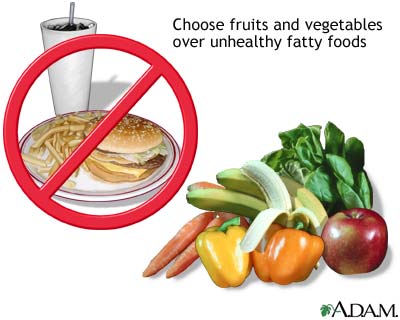
Good nutrition is important for your heart health. Healthy eating habits will help you control some of your risk factors for CHD.
- Eat plenty of fruits, vegetables, and whole grains.
- Choose lean proteins, such as skinless chicken, fish, and beans.
- Eat non-fat or low-fat dairy products, such as skim milk and low-fat yogurt.
- Avoid foods that contain high levels of sodium (salt).
- Read food labels. Avoid foods that contain saturated fat and partially hydrogenated or hydrogenated fats. These are unhealthy fats that are often found in fried foods, processed foods, and baked goods.
- Eat fewer foods that contain cheese, cream, or eggs.
Taking Your Medicines
Your provider may prescribe medicine to treat CHD, high blood pressure, diabetes, or high cholesterol levels. These may include:
- ACE inhibitors
- Beta-blockers
- Calcium channel blockers
- Diuretics (water pills)
- Statins to lower cholesterol
- Nitroglycerin pills or spray to prevent or stop an angina attack
To reduce the risk of a heart attack, you may also be told to take aspirin, clopidogrel (Plavix), ticagrelor (Brilinta) or prasugrel (Effient) every day. Follow your provider's directions carefully to keep heart disease and angina from getting worse.
Always talk to your provider before you stop taking any of your medicines. Stopping these drugs suddenly or changing your dose can make your angina worse or cause a heart attack.
A Plan to Manage Angina
Create a plan with your provider for managing your angina. Your plan should include:
- What activities are OK for you to do, and which ones are not
- What medicines you should take when you have angina
- What are the signs that your angina is getting worse
- When you should call your provider or 911 or the local emergency number
Know what can make your angina worse, and try to avoid these things. For example, some people find that cold weather, exercising, eating large meals, or getting upset or stressed worsens their angina.
Alternative Names
Coronary artery disease - living with; CAD - living with; Chest pain - living with
Images

References
Eckel RH, Jakicic JM, Ard JD, et al. 2013 AHA/ACC guideline on lifestyle management to reduce cardiovascular risk: a report of the American College of Cardiology/American Heart Association Task Force on practice guidelines. Circulation. 2015;131(4):e326. PMID: 24222015 pubmed.ncbi.nlm.nih.gov/24222015/.
Fihn SD, Blankenship JC, Alexander KP, et al. 2014 ACC/AHA/AATS/PCNA/SCAI/STS focused update of the guideline for the diagnosis and management of patients with stable ischemic heart disease: a report of the American College of Cardiology/American Heart Association Task Force on Practice Guidelines, and the American Association for Thoracic Surgery, Preventive Cardiovascular Nurses Association, Society for Cardiovascular Angiography and Interventions, and Society of Thoracic Surgeons. J Am Coll Cardiol. 2014;64(18):1929-1949. PMID: 25077860 pubmed.ncbi.nlm.nih.gov/25077860/.
Morrow DA, de Lemos JA. Stable ischemic heart disease. In: Libby P, Bonow RO, Mann DL, Tomaselli GF, Bhatt DL, Solomon SD, eds. Braunwald's Heart Disease: A Textbook of Cardiovascular Medicine. 12th ed. Philadelphia, PA: Elsevier; 2022:chap 40.
Mozaffarian D. Nutrition and cardiovascular and metabolic diseases. In: Libby P, Bonow RO, Mann DL, Tomaselli GF, Bhatt DL, Solomon SD, eds. Braunwald's Heart Disease: A Textbook of Cardiovascular Medicine. 12th ed. Philadelphia, PA: Elsevier; 2022:chap 29.
Stone NJ, Robinson JG, Lichtenstein AH, et al. 2013 ACC/AHA guideline on the treatment of blood cholesterol to reduce atherosclerotic cardiovascular risk in adults: a report of the American College of Cardiology/American Heart Association Task Force on practice guidelines. J Am Coll Cardiol. 2014;63(25 Pt B):2889-2934. PMID: 24239923 pubmed.ncbi.nlm.nih.gov/24239923/.
Thomasn RJ. Comprehensive cardiac rehabilitation. In: Libby P, Bonow RO, Mann DL, Tomaselli GF, Bhatt DL, Solomon SD, eds. Braunwald's Heart Disease: A Textbook of Cardiovascular Medicine. 12th ed. Philadelphia, PA: Elsevier; 2022:chap 33.
Review Date 8/23/2022
Updated by: Thomas S. Metkus, MD, Assistant Professor of Medicine and Surgery, Johns Hopkins University School of Medicine, Baltimore, MD. Also reviewed by David C. Dugdale, MD, Medical Director, Brenda Conaway, Editorial Director, and the A.D.A.M. Editorial team.