



Overview
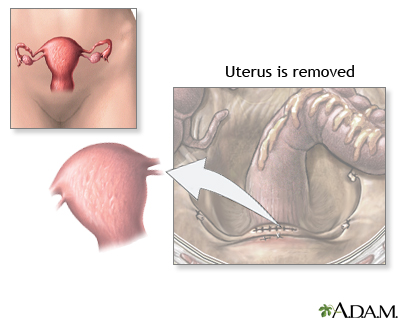
Hysterectomy is a very common operation. The uterus may be completely removed, partially removed, or may be removed with the tubes and ovaries. A partial hysterectomy is removal of just the upper portion of the uterus, leaving the cervix and the base of the uterus are left intact. A total hysterectomy is removal of the entire uterus and the cervix. A radical hysterectomy is the removal of the uterus, both fallopian tubes, both ovaries, and the upper part of the vagina.
A hysterectomy may be done through an abdominal incision (abdominal hysterectomy) or through a vaginal incision (vaginal hysterectomy).
Review Date 1/10/2022
Updated by: John D. Jacobson, MD, Department of Obstetrics and Gynecology, Loma Linda University School of Medicine, Loma Linda, CA. Also reviewed by David Zieve, MD, MHA, Medical Director, Brenda Conaway, Editorial Director, and the A.D.A.M. Editorial team.