



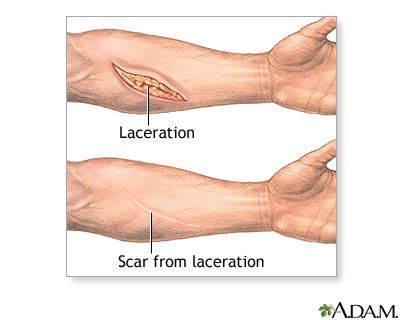
Overview
Skin covers the entire body, and acts as a protective barrier. Scar tissue forms as skin heals after an injury (such as an accident) or surgery. The amount of scarring may be determined by the size, depth, and location of the wound; the age of the person; heredity; and skin characteristics including color (pigmentation).
No scar can be removed completely. The degree of improvement will depend on variables such as the direction and size of the scar, the age of the person, skin type and color, and hereditary factors that may precondition the extent of the healing process.
Review Date 5/26/2023
Updated by: Tang Ho, MD, Associate Professor, Division of Facial Plastic and Reconstructive Surgery, Department of Otolaryngology - Head and Neck Surgery, The University of Texas Medical School at Houston, Houston, TX. Also reviewed by David C. Dugdale, MD, Medical Director, Brenda Conaway, Editorial Director, and the A.D.A.M. Editorial team.