



- Go to slide 1 out of 6
- Go to slide 2 out of 6
- Go to slide 3 out of 6
- Go to slide 4 out of 6
- Go to slide 5 out of 6
- Go to slide 6 out of 6
Overview
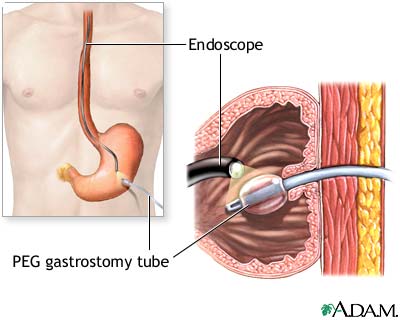
Alternatively, gastrostomy tubes can be placed under endoscopic guidance, using a much smaller incision (percutaneous endoscopic gastrostomy tube placement, or PEG). PEG tube placement can generally be performed under local anesthesia rather than general anesthesia. An endoscope is passed into the mouth, down the esophagus, and into the stomach. The surgeon can then see the stomach wall through which the PEG tube will pass. Under direct visualization with the endoscope, a PEG tube passes through the skin of the abdomen, through a very small incision, and into the stomach. A balloon is then blown up on the end of the tube, holding in place. PEG gastrostomy tubes avoid the need for general anesthesia and a large incision.
Review Date 8/9/2023
Updated by: Michael M. Phillips, MD, Emeritus Professor of Medicine, The George Washington University School of Medicine, Washington, DC. Also reviewed by David C. Dugdale, MD, Medical Director, Brenda Conaway, Editorial Director, and the A.D.A.M. Editorial team.