


![Carbonic-oxide [carbon monoxide] Poisoning with agonal injuries due to a fall, 1898](../../media/thumb/ii_a_106g.jpg "Carbonic-oxide [carbon monoxide] Poisoning with agonal injuries due to a fall, 1898")


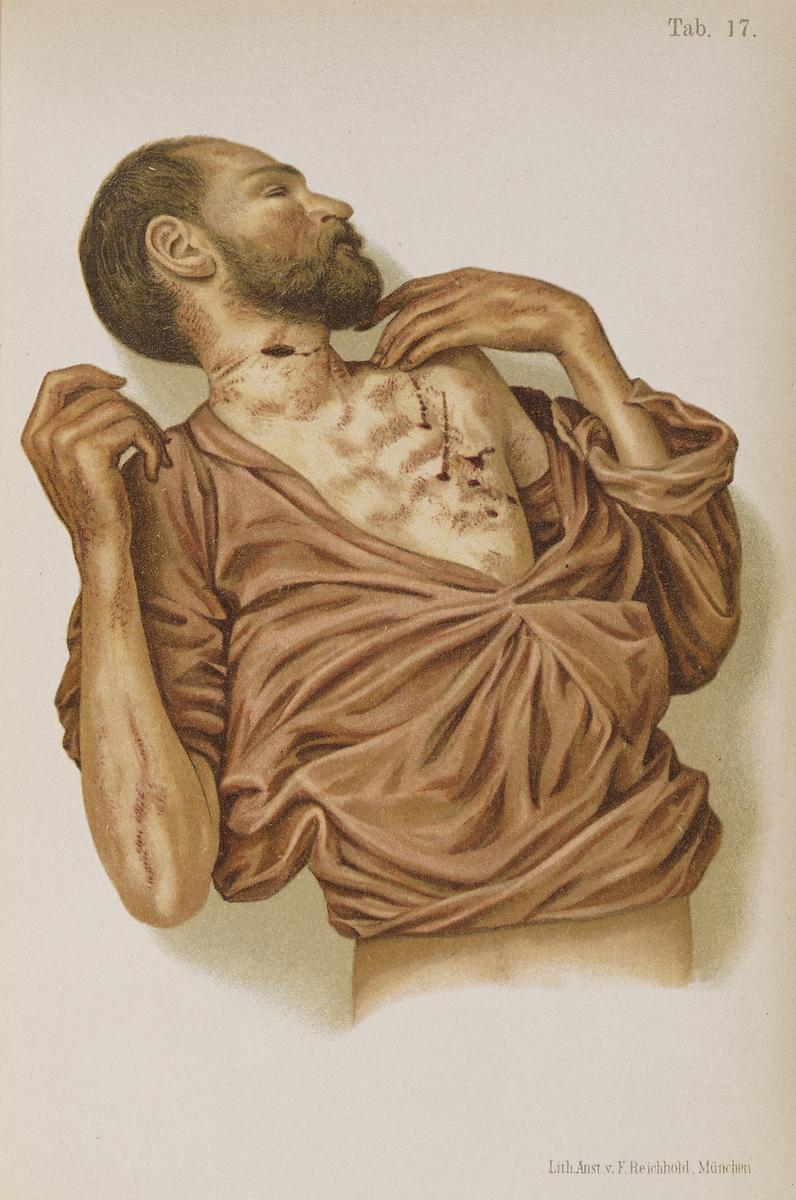
Suicide through Stabbing, 1898
This case is that of a physician who had taken his life in a hotel. His body was found lying upon the left side, behind and across the doorway of the room, so that at first it was not possible to open the barred door. The body was almost entirely covered with freshly coagulated blood, and clothed only with a shirt, which was saturated with blood, opened from the front, and thrown backward. Extensive blood-marks reached from the body to the bed, the covering of which was likewise saturated with blood, and beside which a large, open pocket-knife lay.... After cleansing the body six stab-wounds were recognized. Of these one was situated in the right side of the neck, the other five on the anterior surface of the chest. All of the wounds had a slit-like form, and showed throughout sharp, arched, separated edges, which on both sides joined to form acute angles and between which there was a collection of coagulated blood�. The uppermost [wound] was situated three fingers' breadth below the middle of the left clavicle. It penetrated directly anteroposteriorly the second intercostal space and ended in the lung, which was tuberculous....
That it was a case of suicide was demonstrated by the external circumstances and all the postmortem findings. It was clear that the deceased had produced the wounds while in bed, and that he had then attempted to arise and go to the door, where he fell.... [T]he opened and uninjured shirt, the symmetric disposition of the openings of the stab-wounds and of the course of the canal of the wounds, and the proximity of the wounds of the chest...were more indicative of suicide than of murder... The motive for committing the deed may have been the tuberculous disease.
That it was a case of suicide was demonstrated by the external circumstances and all the postmortem findings. It was clear that the deceased had produced the wounds while in bed, and that he had then attempted to arise and go to the door, where he fell.... [T]he opened and uninjured shirt, the symmetric disposition of the openings of the stab-wounds and of the course of the canal of the wounds, and the proximity of the wounds of the chest...were more indicative of suicide than of murder... The motive for committing the deed may have been the tuberculous disease.
Eduard Ritter von Hofmann, M.D., Atlas of Legal Medicine, Philadelphia, chromolithograph; Artist A. Schmitson
National Library of Medicine