



Overview
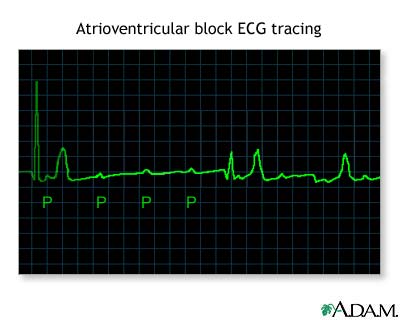
This picture shows an ECG (electrocardiogram, EKG) of a person with an abnormal rhythm (arrhythmia) called an atrioventricular (AV) block. P waves show that the top of the heart received electrical activity. Each P wave is usually followed by the tall (QRS) waves. QRS waves reflect the electrical activity that causes the heart to contract. When a P wave is present and not followed by a QRS wave (and heart contraction), there is an atrioventricular block, and a very slow pulse (bradycardia).
Review Date 5/8/2022
Updated by: Fang JC, O'Gara PT. History and physical examination: an evidence-based approach. In: Libby P, Bonow RO, Mann DL, Tomaselli GF, Bhatt DL, Solomon SD, eds. Braunwald's Heart Disease: A Textbook of Cardiovascular Medicine. 12th ed. Philadelphia, PA: Elsevier Saunders; 2022: chap 13.