



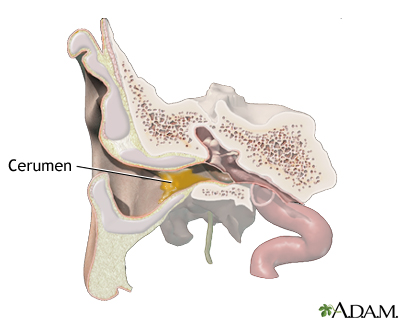
The ear canal is lined with hair follicles. The ear canal also has glands that produce a waxy oil called cerumen. The wax will most often make its way to the opening of the ear. There it will fall out or be removed by washing.
Wax can build up and block the ear canal. Wax blockage is one of the most common causes of hearing loss.
Causes
Ear wax protects the ear by:
- Trapping and preventing dust, bacteria, and other germs and small objects from entering and damaging the ear
- Protecting the delicate skin of the ear canal from getting irritated when water is in the canal
In some people, the glands produce more wax than can be easily removed from the ear. This extra wax may harden in the ear canal and block the ear, causing an impaction. When you try to clean the ear, you may instead push wax deeper and block the ear canal. For this reason, health care providers recommend against trying to reach into your own ear to clean it.
Treatment
Most cases of ear wax blockage can be treated at home. The following remedies can be used to soften wax in the ear:
- Baby oil
- Commercial ear drops
- Glycerin
- Mineral oil
- Water
Another method is to wash out the wax.
- Use body-temperature water (cooler water may cause brief but severe dizziness or vertigo).
- Hold your head upright and straighten the ear canal by holding the outside ear and gently pulling upward.
- Use a syringe (you can buy one at the store) to gently direct a small stream of water against the ear canal wall next to the wax plug.
- Tip your head to allow the water to drain. You may need to repeat irrigation several times.
Ask your health care provider before doing it on your own.
To avoid damaging your ear or causing an infection:
- Never irrigate or use drops to soften the wax in the ear if the eardrum may have a hole in it or you have had recent ear surgery.
- Do not irrigate the ear with a jet irrigator designed for cleaning teeth.
After the wax is removed, dry the ear thoroughly. You may use a few drops of alcohol in the ear or a hair dryer set on low to help dry the ear.
You may clean the outer ear canal by using a cloth or paper tissue wrapped around your finger. Mineral oil can be used to moisturize the ear and prevent the wax from drying.
Do not clean your ears too often or too hard. Ear wax also helps protect your ears. Never try to clean the ear by putting any object, such as a cotton swab, into the ear canal.
If you cannot remove the wax plug or you have discomfort, consult a health care provider, who may remove the wax by:
- Repeating the irrigation attempts
- Suctioning the ear canal
- Using a small device called a curette
- Using a microscope to help
Outlook (Prognosis)
The ear may become blocked with wax again in the future. Hearing loss is often temporary. In most cases, hearing returns completely after the blockage is removed. Hearing aid users should have their ear canal checked for excess wax every 3 to 6 months.
Rarely, trying to remove ear wax may cause an infection in the ear canal. This can also damage the eardrum.
When to Contact a Medical Professional
See your provider if your ears are blocked with wax and you are unable to remove the wax.
Also call if you have an ear wax blockage and you develop new symptoms, such as:
- Drainage from the ear
- Ear pain
- Fever
- Hearing loss that continues after you clean the wax
Alternative Names
Ear impaction; Cerumen impaction; Ear blockage; Hearing loss - ear wax


References
Riviello RJ. Otolaryngologic procedures. In: Roberts JR, Custalow CB, Thomsen TW, eds. Roberts and Hedges' Clinical Procedures in Emergency Medicine and Acute Care. 7th ed. Philadelphia, PA: Elsevier; 2019:chap 63.
Schwartz SR, Magit AE, Rosenfeld RM, et al. Clinical practice guideline (update): earwax (cerumen impaction). Otolaryngol Head Neck Surg. 2017;156(1_suppl):S1-S29. PMID: 28045591 pubmed.ncbi.nlm.nih.gov/28045591/.
Whitaker M. Office-based procedures in otology. In: Myers EN, Snyderman CH, eds. Operative Otolaryngology Head and Neck Surgery. 3rd ed. Philadelphia, PA: Elsevier; 2018:chap 125.
Review Date 5/30/2022
Updated by: Josef Shargorodsky, MD, MPH, Johns Hopkins University School of Medicine, Baltimore, MD. Also reviewed by David C. Dugdale, MD, Medical Director, Brenda Conaway, Editorial Director, and the A.D.A.M. Editorial team.