
| Skip navigation | ||
![]() |
![]() | ![]() |
|
|
||
|
|
|
|
|
|
![]() |
|
|
|
|
|
|
|
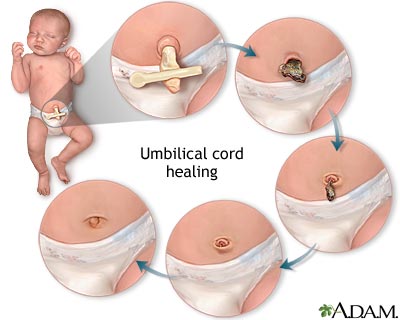
The umbilical cord connects the baby to the mother's placenta. During fetal development in the womb, the umbilical cord is the lifeline to the baby supplying nutrients. After birth, the cord is clamped and cut. Eventually between 1-3 weeks the cord will become dry and will naturally fall off. During the time the cord is healing it should be kept as clean and as dry as possible. |
|
|
|
|
|
|
A.D.A.M., Inc. is accredited by URAC, also known as the American Accreditation HealthCare Commission (www.urac.org). URAC's accreditation program is an independent audit to verify that A.D.A.M. follows rigorous standards of quality and accountability. A.D.A.M. is among the first to achieve this important distinction for online health information and services. Learn more about A.D.A.M.'s editorial policy, editorial process and privacy policy. A.D.A.M. is also a founding member of Hi-Ethics and subscribes to the principles of the Health on the Net Foundation (www.hon.ch). |

| Home | Health Topics | Drugs & Supplements | Encyclopedia | Dictionary | News | Directories | Other Resources | |
| Disclaimers | Copyright | Privacy | Accessibility | Quality Guidelines U.S. National Library of Medicine, 8600 Rockville Pike, Bethesda, MD 20894 National Institutes of Health | Department of Health & Human Services |
Page last updated: 29 October 2009 |