



There are different types of mouth sores. They can occur anywhere in the mouth including bottom of the mouth, inner cheeks, gums, lips, and tongue.
Causes
Mouth sores may be caused by irritation from:
- A sharp or broken tooth or poorly fitting dentures
- Biting your cheek, tongue, or lip
- Burning your mouth from hot food or drinks
- Braces
- Chewing tobacco
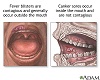
Cold sores are caused by the herpes simplex virus. They are very contagious. Often, you will have tenderness, tingling, or burning before the actual sore appears. Cold sores most often begin as blisters and then crust over. The herpes virus can live in your body for years. It only appears as a mouth sore when something triggers it, such as:
- Another illness, especially if there is a fever
- Hormone changes (such as menstruation)
- Stress
- Sun exposure
Canker sores are not contagious. They may look like a pale or yellow ulcer with a red outer ring. You may have one, or a group of them. Women seem to get them more than men. The cause of canker sores is not clear. It may be due to:
- A weakness in your immune system (for example, from the cold or flu)
- Hormone changes
- Stress
- Lack of certain vitamins and minerals in the diet, including vitamin B12 or folate
Less commonly, mouth sores can be a sign of an illness, tumor, or reaction to a medicine. This can include:
- Autoimmune disorders (including systemic lupus erythematosus)
- Bleeding disorders
- Cancer of the mouth
- Infections such as hand-foot-mouth disease
- Weakened immune system -- for example, if you have AIDS or are taking medicine to suppress your immune system after a transplant
Drugs that may cause mouth sores include aspirin, beta-blockers, chemotherapy medicines, penicillamine, sulfa drugs, and phenytoin.
Home Care
Mouth sores often go away in 10 to 14 days, even if you do not do anything. They sometimes last up to 6 weeks. The following steps can make you feel better:
- Avoid hot beverages and foods, spicy and salty foods, and citrus.
- Gargle with salt water or cool water.
- Eat fruit-flavored ice pops. This is helpful if you have a mouth burn.
- Take pain relievers such as acetaminophen.
For canker sores:
- Apply a thin paste of baking soda and water to the sore.
- Mix 1 part hydrogen peroxide with 1 part water and apply this mixture to the sores using a cotton swab.
- For more severe cases, treatments include fluocinonide gel (Lidex), dexamethasone mouthwash, anti-inflammatory amlexanox paste (Aphthasol), or chlorhexidine gluconate (Peridex) mouthwash.
Over-the-counter medicines, such as Orabase, can protect a sore inside the lip and on the gums. Blistex or Campho-Phenique may provide some relief of canker sores and fever blisters, especially if applied when the sore first appears.
To help cold sores or fever blisters, you can also apply ice to the sore. Acyclovir cream 5% can also be used to help reduce the duration of a cold sore.
To help cold sores or fever blisters, you can also apply ice to the sore.
You may reduce your chance of getting common mouth sores by:
- Avoiding very hot foods or beverages
- Reducing stress and practicing relaxation techniques like yoga or meditation
- Chewing slowly
- Using a soft-bristle toothbrush
- Visiting your dentist right away if you have a sharp or broken tooth or poorly fitting dentures
If you seem to get canker sores often, talk to your provider about taking folate and vitamin B12 to prevent outbreaks.
To prevent cancer of the mouth:
- DO NOT smoke or use tobacco.
- Limit alcohol to 2 drinks per day.
Wear a wide-brimmed hat to shade your lips. Wear a lip balm with SPF 15 at all times.
When to Contact a Medical Professional
Contact your health care provider if:
- The sore begins soon after you start a new medicine.
- You have large white patches on the roof of your mouth or your tongue (this may be thrush or another type of infection).
- Your mouth sore lasts longer than 2 weeks.
- You have a weakened immune system (for example, from HIV or cancer).
- You have other symptoms like fever, skin rash, drooling, or difficulty swallowing.
What to Expect at Your Office Visit
Your provider will examine you, and closely check your mouth and tongue. You will be asked questions about your medical history and symptoms.
Treatment may include:
- A medicine that numbs the area such as lidocaine to ease pain. (DO NOT use in children.)
- An antiviral medicine to treat herpes sores. (However, some experts do not think medicine makes the sores go away sooner.)
- Steroid gel that you put on the sore.
- A paste that reduces swelling or inflammation (such as Aphthasol).
- A special type of mouthwash such as chlorhexidine gluconate (such as Peridex).
Alternative Names
Aphthous stomatitis; Aphthous ulcers; Herpes simplex; Cold sores; Canker sores


References
Jordan RC. Diseases of the mouth and salivary glands. In: Goldman L, Cooney KA, eds. Goldman-Cecil Medicine. 27th ed. Philadelphia, PA: Elsevier; 2024:chap 393.
Simon L, Silk H. Diseases of the mouth. In: Kellerman RD, Rakel DP, Heidelbaugh JJ, Lee EM, eds. Conn's Current Therapy 2023. Philadelphia, PA: Elsevier 2023:1070-1075.
Sciubba JJ. Oral mucosal lesions. In: Flint PW, Francis HW, Haughey BH, et al, eds. Cummings Otolaryngology: Head and Neck Surgery. 7th ed. Philadelphia, PA: Elsevier; 2021:chap 87.
Review Date 9/10/2023
Updated by: Josef Shargorodsky, MD, MPH, Johns Hopkins University School of Medicine, Baltimore, MD. Also reviewed by David C. Dugdale, MD, Medical Director, Brenda Conaway, Editorial Director, and the A.D.A.M. Editorial team.