



Overview
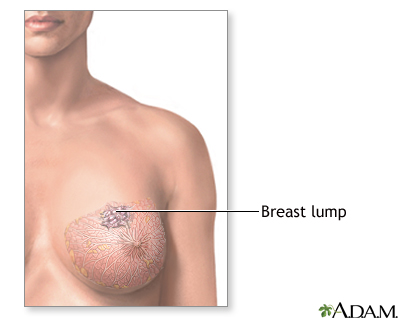
Most breast lumps are not diagnosed by a healthcare provider, but are detected by women who give themselves breast self-examinations. Any breast lump that persists beyond a few days should be reported to a healthcare provider. Almost two-thirds of all breast lumps are benign, but the chance of a malignant lump is greatly increased if the woman is past menopause. Ultrasound and mammogram may be used to see if a lump is a cyst filled with fluid or a solid mass of tissue. If the lump is a cyst, it can be left alone or aspirated if it causes symptoms. If a cyst appears suspicious on imaging, needle aspiration or needle biopsy can be performed. If the lump is a solid mass, the next step is usually a needle biopsy performed by a radiologist or breast specialist. The tissue is checked by a pathologist to see if it is cancer or not.
Review Date 2/2/2023
Updated by: Mark Levin, MD, Hematologist and Oncologist, Monsey, NY. Review provided by VeriMed Healthcare Network. Also reviewed by David C. Dugdale, MD, Medical Director, Brenda Conaway, Editorial Director, and the A.D.A.M. Editorial team. Editorial update 06/05/2023.