



Overview
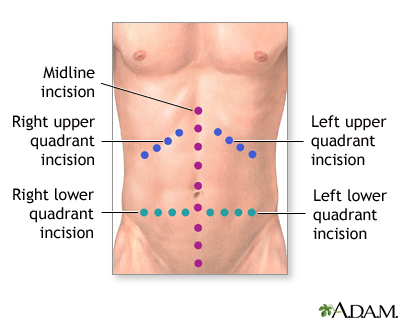
While the patient is deep asleep and pain-free (general anesthesia), the surgeon makes an incision into the abdomen and examines the abdominal organs. Different incisions are sometimes used depending on the circumstance. Common incisions include a vertical midline incision, and right or left upper or lower quadrant transverse incisions. Tissue samples (biopsies) can be taken and diseased areas can be evaluated. When the treatment is complete, the incision is closed with either sutures or skin staples.
Review Date 2/28/2022
Updated by: Debra G. Wechter, MD, FACS, General Surgery Practice Specializing in Breast Cancer, Virginia Mason Medical Center, Seattle, WA. Also reviewed by David Zieve, MD, MHA, Medical Director, Brenda Conaway, Editorial Director, and the A.D.A.M. Editorial team.