
| Skip navigation | ||
![]() |
![]() | ![]() |
|
|
||
|
|
|
|
|
|
|
|
||
|
|
|
|
||
|
|
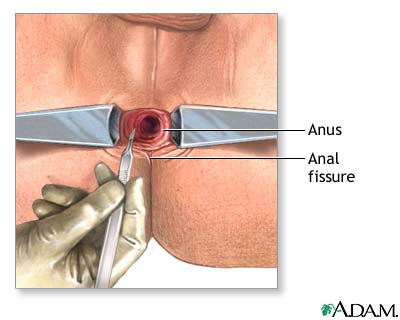
Most anal fissures can be treated successfully with conservative measures, which include stool softeners and warm soaks. The goal is to relax the anal sphincter, which allows the fissure to heal. If these methods are ineffective, surgery is necessary. This is called an internal sphincterotomy, a procedure in which the anal sphincter is partially cut, thus allowing it to relax and permitting the fissure to heal.
|
|
||
|
|
|
|
|
A.D.A.M., Inc. is accredited by URAC, also known as the American Accreditation HealthCare Commission (www.urac.org). URAC's accreditation program is an independent audit to verify that A.D.A.M. follows rigorous standards of quality and accountability. A.D.A.M. is among the first to achieve this important distinction for online health information and services. Learn more about A.D.A.M.'s editorial policy, editorial process and privacy policy. A.D.A.M. is also a founding member of Hi-Ethics and subscribes to the principles of the Health on the Net Foundation (www.hon.ch). |

| Home | Health Topics | Drugs & Supplements | Encyclopedia | Dictionary | News | Directories | Other Resources | |
| Disclaimers | Copyright | Privacy | Accessibility | Quality Guidelines U.S. National Library of Medicine, 8600 Rockville Pike, Bethesda, MD 20894 National Institutes of Health | Department of Health & Human Services |
Page last updated: 29 October 2009 |