



Overview
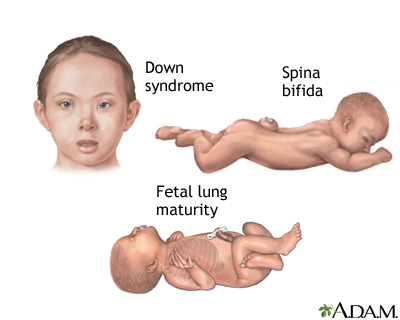
Amniocentesis helps in detecting or ruling out Down's syndrome, which causes intellectual disability, congenital heart defects, and physical characteristics such as skin folds near the eyes. Amniocentesis also detects neural tube defects such as spina bifida. Babies born with spina bifida have a backbone that did not close properly. Serious complications of spina bifida can include leg paralysis, bladder and kidney defects, brain swelling (hydrocephalus), and intellectual disability.
If your pregnancy is complicated by a condition such as Rh-incompatibility, your doctor can use amniocentesis to find out if your baby's lungs are developed enough to endure an early delivery. Many more diagnoses are available through amniocentesis.
Review Date 8/23/2023
Updated by: LaQuita Martinez, MD, Department of Obstetrics and Gynecology, Emory Johns Creek Hospital, Alpharetta, GA. Also reviewed by David C. Dugdale, MD, Medical Director, Brenda Conaway, Editorial Director, and the A.D.A.M. Editorial team.