



Platelets are small cells in your blood that your body uses to form clots and stop bleeding. If you have too many platelets or your platelets stick together too much, you are more likely to form clots. This clotting can take place on the inside of your arteries and lead to heart attack or stroke.
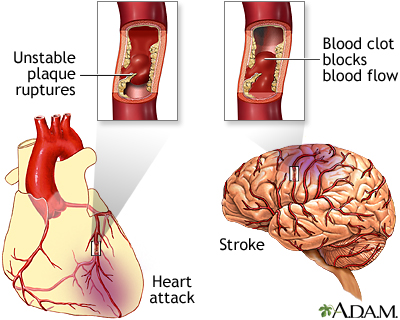
Antiplatelet drugs work to make your platelets less sticky and thereby help prevent blood clots from forming in your arteries.
- Aspirin is an antiplatelet drug that may be used.
- P2Y12 receptor blockers are another group of antiplatelet drugs. This group of drugs includes: clopidogrel, ticlopidine, ticagrelor, prasugrel, and cangrelor.
Who Should Take Antiplatelet Drugs
Antiplatelet drugs may be used to:
- Prevent heart attack or stroke for those with peripheral arterial disease (most often blockage of an artery in the leg).
- Clopidogrel (Plavix, generic) may be used in place of aspirin for people who have narrowing of the coronary arteries or who have had a stent inserted.
- Sometimes 2 antiplatelet drugs (one of which is almost always aspirin) are prescribed for people with acute coronary syndrome (unstable angina or heart attack), or those who have received a coronary stent during PCI.
- Aspirin and a second antiplatelet drug are usually recommended for people who are undergoing angioplasty with or without stenting.
- Prevent or treat heart attacks.
- Prevent stroke or transient ischemic attacks (TIAs are early warning signs of stroke. They are also called "mini-strokes.")
- Prevent clots from forming inside stents put inside your arteries to open them.
- Acute coronary syndrome.
- After bypass graft surgery that uses a man-made or prosthetic graft performed on arteries below the knee.
Your health care provider will choose which one of these drugs are best for your problem. At times, you may be asked to take low dose aspirin along with one of these drugs.
Side Effects
Side effects of this medicine may include:
- Diarrhea
- Itching
- Nausea
- Skin rash
- Stomach pain
Before you start taking these medicines, tell your provider if:
- You have bleeding problems or stomach ulcers.
- You are pregnant, plan to become pregnant, or are breastfeeding.
There are a number of other possible side effects, depending on which drug you are prescribed. For example:
- Ticlopidine may lead to a very low white blood cell count or an immune disorder that destroys platelets.
- Ticagrelor may cause episodes of shortness of breath.
Taking P2Y12 Inhibitors
This medicine is taken as a pill. Your provider may change your dose from time to time.
Take this medicine with food and plenty of water to reduce side effects. You may need to stop taking clopidogrel before you have surgery or dental work. Do not just stop taking your medicine without first talking with your provider.
Talk with your provider before taking any of these drugs:
- Heparin and other blood thinners, such as warfarin (Coumadin)
- Pain or arthritis medicine that are NSAIDs (such as diclofenac, etodolac, ibuprofen, indomethacin, Advil, Aleve, Daypro, Dolobid, Feldene, Indocin, Motrin, Orudis, Relafen, or Voltaren)
- Phenytoin (Dilantin), tamoxifen (Nolvadex, Soltamox), tolbutamide (Orinase), or torsemide (Demadex)
Do not take other drugs that may have aspirin or ibuprofen in them before talking with your provider. Read the labels on cold and flu medicines. Ask what other medicines are safe for you to take for aches and pains, colds, or the flu.
If you have any type of procedure scheduled, you may need to stop these drugs 5 to 7 days before hand. However, always check with your provider first about whether it is safe to stop.
Tell your provider if you are pregnant or planning to become pregnant, or breastfeeding or planning to breastfeed. Women in the later stages of pregnancy should not take clopidogrel. Clopidogrel can be passed to infants through breast milk.
Talk with your provider if you have liver or kidney disease.
If you miss a dose:
- Take it as soon as possible, unless it is time for your next dose.
- If it is time for your next dose, take your usual amount.
- Do not take extra pills to make up for a dose you have missed, unless your doctor tells you to.
Store these drugs and all other medicines in a cool, dry place. Keep them where children cannot get to them.
When to Call the Doctor
Contact your provider if you have any of these side effects and they do not go away:
- Any signs of unusual bleeding, such as blood in the urine or stools, nosebleeds, any unusual bruising, heavy bleeding from cuts, black tarry stools, coughing up blood, heavier than usual menstrual bleeding or unexpected vaginal bleeding, vomit that looks like coffee grounds
- Dizziness
- Difficulty swallowing
- Tightness in your chest or chest pain
- Swelling in your face or hands
- Itching, hives, or tingling in your face or hands
- Wheezing or difficulty breathing
- Very bad stomach pain
- Skin rash
Alternative Names
Blood thinners - clopidogrel; Antiplatelet therapy - clopidogrel; Thienopyridines
Images

References
Abraham NS, Hlatky MA, Antman EM, et al. ACCF/ACG/AHA 2010 expert consensus document on the concomitant use of proton pump inhibitors and thienopyridines: a focused update of the ACCF/ACG/AHA 2008 expert consensus document on reducing the gastrointestinal risks of antiplatelet therapy and NSAID use: a report of the American College of Cardiology Foundation Task Force on Expert Consensus Documents. Circulation. 2010;122(24):2619-2633. PMID: 21060077 pubmed.ncbi.nlm.nih.gov/21060077/.
Alberts MJ. Prevention and management of ischemic stroke. In: Libby P, Bonow RO, Mann DL, Tomaselli GF, Bhatt DL, Solomon SD, eds. Braunwald's Heart Disease: A Textbook of Cardiovascular Medicine. 12th ed. Philadelphia, PA: Elsevier; 2022:chap 45.
Fihn SD, Blankenship JC, Alexander KP, et al. 2014 ACC/AHA/AATS/PCNA/SCAI/STS focused update of the guideline for the diagnosis and management of patients with stable ischemic heart disease: a report of the American College of Cardiology/American Heart Association Task Force on Practice Guidelines, and the American Association for Thoracic Surgery, Preventive Cardiovascular Nurses Association, Society for Cardiovascular Angiography and Interventions, and Society of Thoracic Surgeons. J Am Coll Cardiol. 2014;64(18):1929-1949. PMID: 25077860 pubmed.ncbi.nlm.nih.gov/25077860/.
January CT, Wann LS, Calkins H, et al. 2019 AHA/ACC/HRS focused update of the 2014 AHA/ACC/HRS guideline for the management of patients with atrial fibrillation: a report of the American College of Cardiology/American Heart Association Task Force on clinical practice guidelines and the Heart Rhythm Society. J Am Coll Cardiol. 2019;74(4):599. PMID: 30703431 pubmed.ncbi.nlm.nih.gov/30703431/.
Kumbhani DJ, Bhatt DL. Percutaneous coronary intervention. In: Libby P, Bonow RO, Mann DL, Tomaselli GF, Bhatt DL, Solomon SD, eds. Braunwald's Heart Disease: A Textbook of Cardiovascular Medicine. 12th ed. Philadelphia, PA: Elsevier; 2022:chap 41.
Meschia JF, Bushnell C, Boden-Albala B, et al. Guidelines for the primary prevention of stroke: a statement for healthcare professionals from the American Heart Association/American Stroke Association. Stroke. 2014;45(12):3754-3832. PMID: 25355838 pubmed.ncbi.nlm.nih.gov/25355838/.
Morrow DA, de Lemos JA. Stable ischemic heart disease. In: Libby P, Bonow RO, Mann DL, Tomaselli GF, Bhatt DL, Solomon SD, eds. Braunwald's Heart Disease: A Textbook of Cardiovascular Medicine. 12th ed. Philadelphia, PA: Elsevier; 2022:chap 40.
Powers WJ, Rabinstein AA, Ackerson T, et al. Guidelines for the early management of patients with acute ischemic stroke: 2019 update to the 2018 Guidelines for the early management of patients with acute ischemic stroke: a guideline for healthcare professionals from the American Heart Association/American Stroke Association. Stroke. 2019;50(12):e344-e418. PMID: 31662037 pubmed.ncbi.nlm.nih.gov/31662037/.
Read More
- Angina
- Angioplasty and stent placement - carotid artery
- Angioplasty and stent placement - peripheral arteries
- Aortic valve surgery - minimally invasive
- Aortic valve surgery - open
- Cardiac ablation procedures
- Carotid artery surgery - open
- Chronic obstructive pulmonary disease (COPD)
- Coronary heart disease
- Heart bypass surgery
- Heart bypass surgery - minimally invasive
- Heart failure
- Heart pacemaker
- High blood cholesterol levels
- High blood pressure in adults – hypertension
- Implantable cardioverter-defibrillator
- Mitral valve surgery - minimally invasive
- Mitral valve surgery - open
- Peripheral artery bypass - leg
- Peripheral artery disease - legs
Patient Instructions
- Angina - discharge
- Angioplasty and stent - heart - discharge
- Angioplasty and stent placement - carotid artery - discharge
- Angioplasty and stent placement - peripheral arteries - discharge
- Aspirin and heart disease
- Atrial fibrillation - discharge
- Being active when you have heart disease
- Cardiac catheterization - discharge
- Carotid artery surgery - discharge
- Controlling your high blood pressure
- Diabetes - preventing heart attack and stroke
- Heart attack – discharge
- Heart bypass surgery - discharge
- Heart bypass surgery - minimally invasive - discharge
- Heart failure - discharge
- Heart valve surgery - discharge
- Peripheral artery bypass - leg - discharge
- Stroke - discharge
Review Date 8/23/2022
Updated by: Thomas S. Metkus, MD, Assistant Professor of Medicine and Surgery, Johns Hopkins University School of Medicine, Baltimore, MD. Also reviewed by David C. Dugdale, MD, Medical Director, Brenda Conaway, Editorial Director, and the A.D.A.M. Editorial team.