



- Go to slide 1 out of 5
- Go to slide 2 out of 5
- Go to slide 3 out of 5
- Go to slide 4 out of 5
- Go to slide 5 out of 5
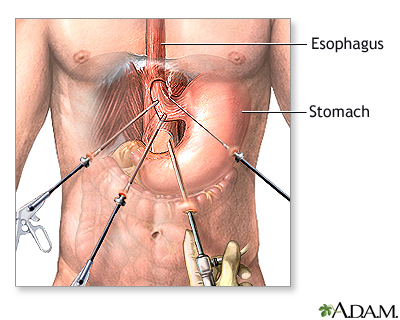
Overview
The surgeon then makes a long incision in the esophagus at the level of the esophageal sphincter. This releases the sphincter and allows it to relax. This surgery is very effective in curing achalasia, with over 90% of patients obtaining relief from symptoms post-operatively.
Recovery is generally rapid, and most patients are able to leave the hospital within 1 to 3 days. Infrequently, the operation cannot be accomplished laparoscopically, and a larger incision is required. In these cases, hospitalization times may be longer.
Review Date 10/25/2021
Updated by: Michael M. Phillips, MD, Emeritus Professor of Medicine, The George Washington University School of Medicine, Washington, DC. Also reviewed by David Zieve, MD, MHA, Medical Director, Brenda Conaway, Editorial Director, and the A.D.A.M. Editorial team.