This is archived content.
Links may have become inactive over time. Visit Archive-It to find the original published layout.
Hands On
The Hands On column in this issue is highlighting PubMed's informative online Help (http://www.ncbi.nlm.nih.gov:80/entrez/query/static/help/pmhelp.html) and PubMed's FAQs (http://www.ncbi.nlm.nih.gov:80/entrez/query/static/faq.html). Both are available as links from the PubMed sidebar. Answering your own question can be as easy as "click, scroll, click." Next time you have a question, give these resources a try.
Question:
Why is "AND notpubref [sb]" included in the search strategy in the PubMed Query box?
Answer:
The answer is found in PubMed's FAQs under "Why does the Details of my search show "AND notpubref [sb]" in every search?" at http://www.ncbi.nlm.nih.gov:80/entrez/query/static/faq.html#Pubref. See also the article in this issue about the expanded scope (http://www.nlm.nih.gov/pubs/techbull/nd99/nd99_scope.html) of PubMed and MEDLINE.
Question:
How can I tell if my browser accepts cookies?
Answer:
This answer is also found in PubMed's FAQs under "How can I tell if my browser accepts cookies?" at http://www.ncbi.nlm.nih.gov:80/entrez/query/static/faq.html #Acceptscookies. See also the PubMed FAQ, What is a "cookie?" at http://www.ncbi.nlm.nih.gov:80/entrez/query/static/faq.html#Cookie.
Question:
What happens when I enter unqualified terms in the new version of PubMed?
Answer:
The Automatic Term Mapping feature has not changed in the new PubMed; it is described in PubMed's Help section on Automatic Term Mapping at http://www.ncbi.nlm.nih.gov:80/entrez/query/static/help/pmhelp.html #AutomaticTermMapping. PubMed still compares terms against four Translation Tables:
- MeSH
- Journal
- Phrase List
- Author
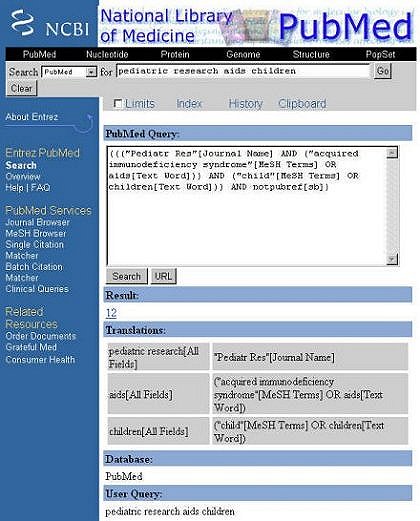
For example, if you enter pediatric research aids children in the query box, PubMed first checks to see if the entire string matches in any of the Translation Tables. If not, PubMed breaks apart this long phrase from right to left using the Automatic Term Mapping Process (see Figure 1).
Figure 1 - Query "pediatric research aids children"
| Searches for: | If: | Action: |
|---|---|---|
| pediatric research aids children | no match | removes term on right - re-runs automatic term mapping process |
| pediatric research aids | no match | removes term on right - re-runs automatic term mapping |
| pediatric research | match found in Journal Table | pediatric research will be searched as "Pediatr Res"[Journal Name] |
| aids children | no match | removes term on right - re-runs automatic term mapping |
| aids | match found in MeSH Translation Table | aids searches as "acquired immunodeficiency syndrome"[MeSH Terms] OR aids[Text Word] |
| children | match found in MeSH Translation Table | children searched as "child"[MeSH Terms] OR children[Text Word] |
For searches that find no matches from the right-to-left process, PubMed starts the Automatic Term Mapping process over from left-to-right. Remaining terms with no match in any of the Translation Tables are searched in All Fields and then ANDed together.
Once you have executed your search and the results are displayed, click the Details button to see PubMed's search strategy. In particular, notice the Translations area of Details where the mappings are clearly explained (see Figure 2).
Figure 2 - Details for "pediatric research aids children" Search
- --prepared by Nadine Benton
- MEDLARS Management Section

