This is a preview of updates coming to the Technical Bulletin's website in April 2026. Return to current site.
Read more about the modernization release schedule in this announcement.
Comment via the yellow feedback button in the lower right hand corner of the page. Contact the NLM Help Desk with any questions or concerns.
This is archived content.
Links may have become inactive over time. Visit Archive-It to find the original published layout.
What's New for 2010 MeSH®
Schulman JL. What's New for 2010 MeSH®. NLM Tech Bull. 2009 Nov-Dec;(371):e15.
December 18, 2009 [posted]
Overview of Vocabulary Development and Changes for 2010 MeSH
- 422 Descriptors added
- 52 Descriptor terms replaced with more up-to-date terminology
- 20 Descriptors deleted
Totals by Type of Terminology
- 25,588 Descriptors
- 83 Qualifiers
- 186,686 Supplementary Concept Records (SCRs)
Helpful Links
Please consult the 2010 online Introduction to MeSH for more details. Lists of new and changed vocabulary are available at these links:
- MeSH Vocabulary Changes
- New Descriptors - 2010
- Changed Descriptors - 2010
- Deleted Descriptors - 2010
- New Descriptors by Tree Subcategory - 2010
In addition, files of MeSH 2010 vocabulary are also available for downloading.
Major Tree Revisions
For 2010 MeSH, the Category B (Organisms Tree) was reorganized to include specific taxonomic descriptors for the third domain of life (Eukaryota). The descriptor Protozoa, formerly under Invertebrates, was deleted because it has become an outmoded phylogenetic concept. The vast majority of new descriptors treed under Eukaryota comprise most of the organisms that were previously treed under the old Protozoa.
The 20th century classification of Protozoa emphasized modes of nutrition and locomotion; 21st century classification is based on ultrastructure, biochemistry, and genetics. Most of the organism descriptors that were treed under Protozoa are now treed under Eukaryota, some under different taxonomic names. Note these organisms are no longer treed under Animals and will not get the check tag Animals; they are simply eukaryotes. Common usage of the word "protozoan" still exists in the literature, though it is diminishing; for now we are going to retain the other MeSH descriptors with the word "Protozoan." Thus the headings Protozoan Infections, Protozoan Genes, and Protozoan Proteins, etc. have not changed.
For more detailed information on these changes see 2010 MeSH® Category B Restructuring and MEDLINE® Data Changes — 2010.
H1N1 Virus
Influenza A Virus, H1N1 Subtype for the causative agent of what is colloquially called "swine flu." It has entry terms H1N1 Virus and Swine-Origin Influenza A H1N1 Virus. The disease coordinate for H1N1 in humans is Influenza, Human. There are no references to "swine flu" in MeSH due to its ambiguous meaning (analogous to "bird flu"). For more indexing details, see 2009 H1N1 Flu ("Swine Flu") Terminology.
Rare Diseases
Under an agreement with the NIH Office of Rare Diseases and Research (ORDR), the list of rare disease terms maintained by that office is being merged into the MeSH vocabulary. During the initial review process of 10,379 ORDR terms, 1,332 ORDR terms were deleted because they were abbreviations of fewer than five letters and therefore would have created ambiguity if included in MeSH. A total of 274 ORDR terms were merged with existing descriptors in MeSH 2010. This increase is in addition to the 440 ORDR terms that were identified as being already in MeSH 2010 descriptors. An additional 372 ORDR terms were identified during this review process to be merged with MeSH 2011 descriptors. The remainder are targeted to be Supplementary Concept Records (Class 3) in MeSH 2011. Each of these rare disease SCR records will be mapped to (Heading Mapped to) at least one current MeSH disease term to help future searches and indexing.
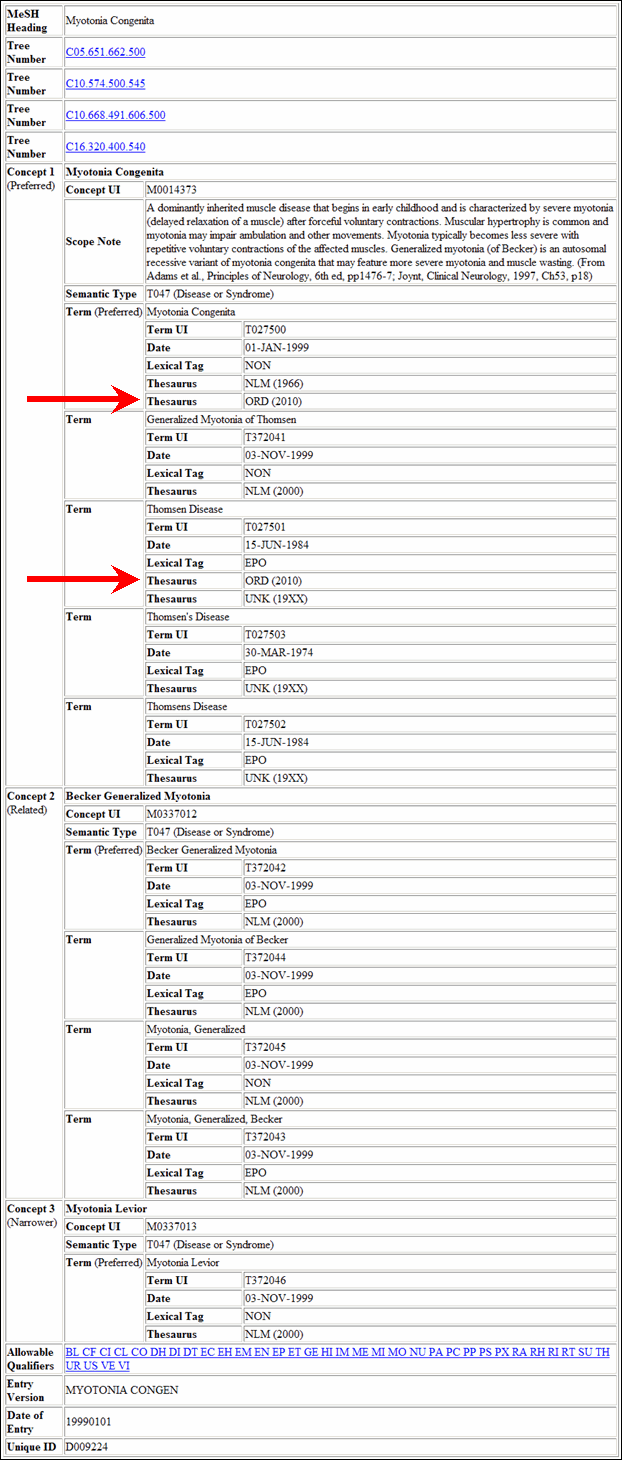
For example, ORDR disease term Myotonia Congenita matches the existing MeSH descriptor Myotonia Congenita (D009224). The ORDR related term Thomsen Disease is an Entry Term for Myotonia Congenita. See Figure 1; note the ORDR terms are identified by the label Thesaurus with a value of ORD (2010). This particular concept will have additional edits targeted for the 2011 MeSH.